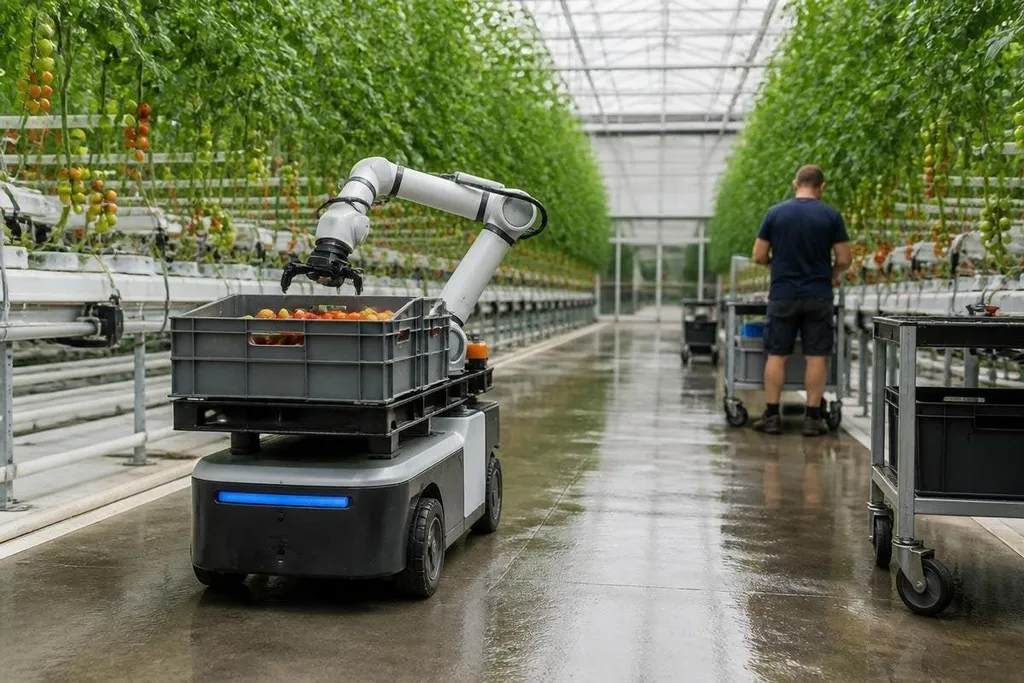
Greenhouse robots can move crops, inspect plants, remove weeds, and support harvest work. Their value depends on how well they handle wet floors, changing light, delicate produce, and the layout of your site.
Quick read
- Robots fit repeatable jobs such as crop transport, plant checks, and targeted spraying.
- Cameras can find plant problems, but poor light, leaves, and water can confuse them.
- A useful purchase needs a clear task, safe human handoffs, and a repair plan.
Where robots can help
Greenhouses give robots a fixed working area, which makes indoor automation easier to plan than work across open fields. A mobile robot can follow marked routes between rows and carry trays, tools, or harvested produce.
That task matters when staff spend large parts of a shift walking, pushing carts, or carrying loads. A robot can handle the route while a worker checks crop quality, fills trays, or makes decisions that need plant knowledge.
Inspection is another fit. Cameras mounted on a moving robot can record plant images at set points. Software can then flag changes in leaf color, plant size, or fruit position for a worker to check.
The camera does not need to make the final call to be useful. A clear list of plants that need attention can help a grower spend time where it matters instead of checking every row in the same way.
Where the hardware struggles
Plants do not present clean targets. Leaves overlap, fruit hides behind stems, and workers may block the robot’s view.
Water on a camera lens can also reduce image quality, while shade and strong sun can change what the camera sees from one row to the next.
Delicate crops add another problem. A gripper must touch fruit and stems with enough control to avoid damage. That means the robot needs accurate sensing, careful motion, and a way to stop when the plant does not match the expected shape.
A greenhouse floor can also change during the day. Mud, standing water, cables, loose trays, and narrow paths can block a mobile robot. The robot may work well on a clear test route and still need help during a busy harvest period.
Maintenance deserves the same attention as the robot’s task. Fans, cameras, batteries, wheels, and grippers all need checks. If a failed robot blocks a row or stops a delivery route, staff still need a manual way to finish the work.
The people and safety risk
A robot shares space with workers, carts, ladders, and visitors. Its route should be clear, its stopping behavior should be easy to understand, and its controls should be reachable by the people who work near it.
Human handoffs need special care. A worker may take a tray from the robot, place a tray on it, or remove an item after an inspection. The handoff should have one clear position and one clear signal, so nobody has to guess when the robot will move.
Data raises a separate question. Plant images can help with crop checks, but you should know where those images go, who can view them, and how long they stay there. If cameras also record workers, the site needs a clear rule for that footage.
Privacy is one part of the buying decision. Robot24.com greenhouse robotics reports set out the crop, test site, date, and worker tasks left after each run, giving you facts to weigh before you compare price and labor.
What to check before buying
A short site test should answer practical questions before you sign a purchase order. Use this checklist:
- Name one task: Pick a job with a clear start, finish, and result.
- Map the route: Check doors, row width, floor changes, charging points, and places where people cross.
- Test the crop: Run the robot across different plant sizes, light levels, and growth stages.
- Watch the handoff: Ask staff to load, unload, stop, and restart the robot during normal work.
- Price the support: Include spare parts, software fees, training, service visits, and time lost during repairs.
- Keep a manual path: Make sure workers can finish the task if the robot stops.
A sensible first step
Start with a task that repeats often and causes little crop risk, such as moving empty trays or carrying packed produce along a fixed route. That gives you a useful test of charging, traffic, cleaning, and staff response before the robot handles a living plant.
I’d delay plant picking until the supplier shows the robot working on your crop, in your light, with your workers nearby. A greenhouse robot earns its place when it keeps doing one useful job after the demo ends; the open question is how long that proof lasts on your busiest day.